
Broken Tracking Is Quietly Wasting Your Marketing Budget
If you can't trust your data, every budget decision is a guess. Broken tracking and attribution leak revenue by hiding which channels actually work — so you scale the losers and starve the winners.
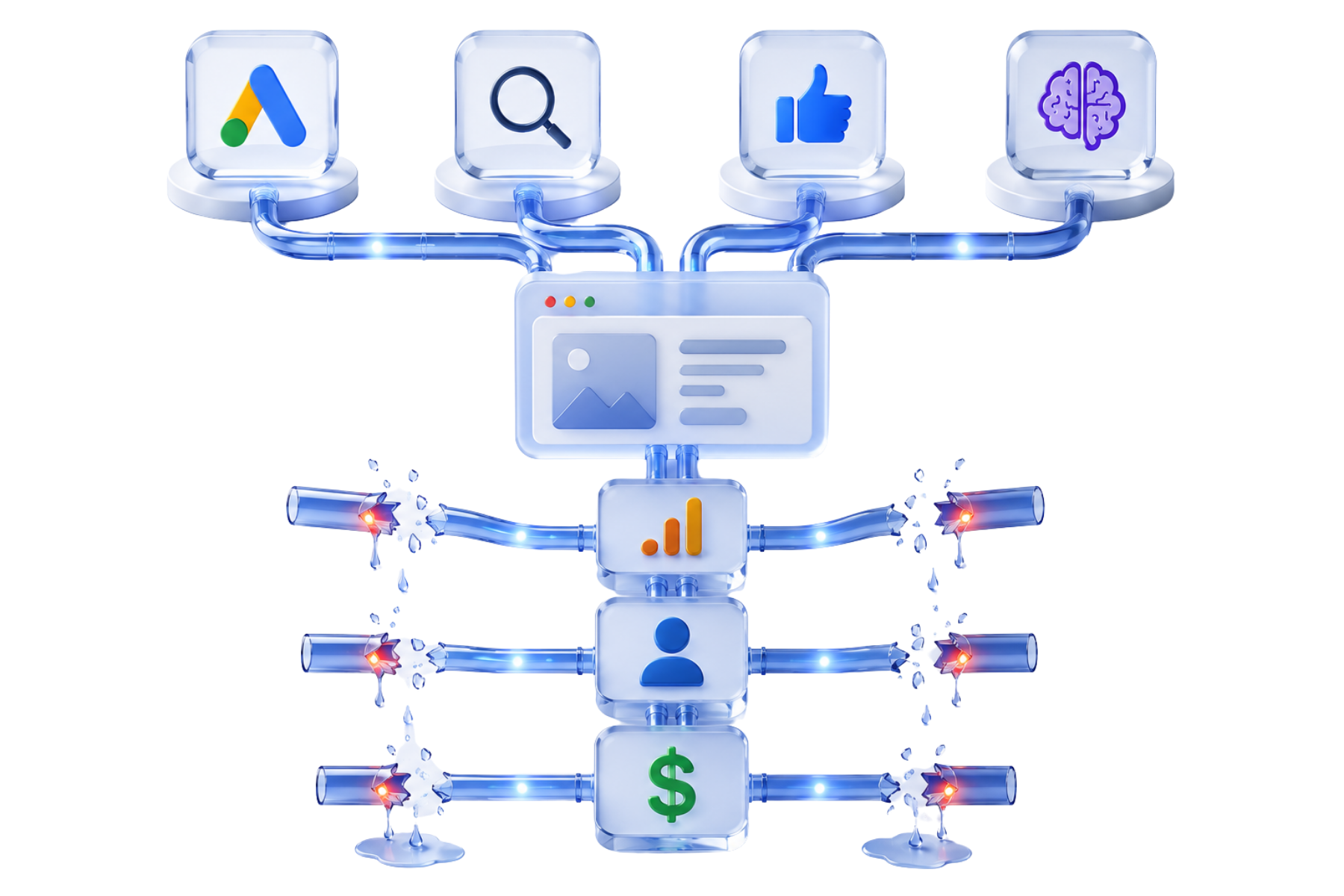
Why Broken Tracking Creates Hidden Revenue Leaks
Many businesses invest heavily in Google Ads, SEO, social media, and other marketing channels, yet still struggle to answer one simple question:
Which marketing activities actually generate revenue?
The problem is rarely a lack of traffic. More often, the issue is incomplete or inaccurate tracking. When attribution systems are broken, businesses lose visibility into the customer journey and start making decisions based on assumptions rather than data.
A visitor might click a Google Ad, browse several pages, submit a form, speak with a sales rep, and eventually become a paying customer. Without proper tracking, those interactions become disconnected. Marketing platforms may never receive accurate conversion signals, which makes optimization significantly harder.
As a result, budgets keep flowing into campaigns that look successful on the surface but fail to generate meaningful business outcomes. At the same time, high-performing channels often receive less investment because their true value stays hidden. This creates one of the most common revenue leaks in modern marketing:
- Advertising spend increases without clear performance visibility
- Marketing reports show incomplete or inaccurate data
- Lead sources become difficult to identify
- Sales teams can't connect revenue back to campaigns
- Optimization decisions rest on assumptions instead of behavior
- Profitable opportunities remain undiscovered
Over time, these attribution gaps compound — you spend more acquiring traffic while learning less about what actually drives growth. Accurate tracking changes that. When marketing platforms, analytics, CRM data, and revenue reporting are properly connected through a real analytics and tracking setup, you get a complete view of the customer journey: which channels are profitable, where to improve, and where spend is wasted. The goal of attribution isn't collecting more data — it's understanding how marketing activity turns into leads, customers, and revenue.
Fix tracking, and the same budget starts working harder. Accurate data lets you:
Every customer travels through the same chain:
Every disconnected step creates a potential revenue leak. If the source is lost at the website, dropped in GA4, or never reaches the CRM, the revenue still happens — but you can no longer tell what produced it.
The Marketing Blind Spots Most Businesses Have
Here's a simple test. Ask yourself these questions about your own business. If the honest answer to most of them is "I'm not sure," you have a tracking problem — not a marketing problem.
- Which channel brought in your last 10 customers?
- How much does one real customer cost you to acquire?
- Which keyword or campaign actually produced revenue last month?
- How many of your leads ever turn into paying customers?
- Are phone calls counted as conversions, or invisible?
- If you doubled your ad budget tomorrow, would you know what it returned?
"I don't know" is the most expensive answer in marketing. Every blind spot is a place where money moves without anyone watching — and where good campaigns get cut while bad ones get scaled.
None of these questions require a marketing degree to care about. They're business questions. The reason most owners can't answer them isn't that the data doesn't exist — it's that the systems holding the data were never connected.
What Is Attribution, In Plain English?
Forget the jargon for a moment. Attribution is simply the ability to answer one question: "What caused this customer to buy?"
When someone becomes a customer, they didn't appear out of nowhere. They found you somehow — a Google search, an ad, a referral, a social post, an AI assistant recommending you. Attribution is the practice of connecting that first spark to the final sale, so you know which efforts are worth repeating.
Think of it like a receipt for your marketing. Without it, you're spending money and hoping. With it, you can say: "This channel brought in $40,000 last quarter, and this one brought in $2,000 — so let's move budget toward the first one." That single shift, repeated over months, is the difference between marketing that compounds and marketing that drains.
Good attribution doesn't mean collecting more data. It means connecting the data you already have so it tells a story that ends in revenue.
The mechanics of how attribution is set up — tags, events, models, server-side tracking — are what a proper analytics and tracking setup handles for you. But the idea itself is simple, and once you understand it, you'll spot the gaps in your own marketing immediately.
The Customer Journey Most Businesses Never See
Every customer travels through the same path before they buy. When tracking is clean, you can follow each step. When it breaks at any stage, that part of the journey simply disappears — and you lose the ability to see what's working.
When tracking breaks at any stage, the journey becomes invisible. And invisible journeys create revenue leaks — the channel that earned the customer gets no credit, so it gets defunded while weaker channels keep your budget.
The Revenue Journey: From Click To Cash
The customer journey above is about behavior. The revenue journey is about money — and it's the version your accountant cares about. Every business, in every industry, moves people through the same six stages:
Most businesses only measure the two ends of this chain: how much traffic they get, and how much money lands in the bank. Everything in the middle — the part that explains why revenue went up or down — stays invisible.
That's a problem, because the leak is almost always in the middle. You might get plenty of traffic but few leads. Plenty of leads but few that are qualified. Plenty of appointments but few that close. When you can see each stage, you can find the exact step that's costing you money instead of guessing. When you can't, you end up "fixing" the wrong stage entirely — pouring more budget into traffic when the real problem was that half your leads were never followed up.
Where Tracking Usually Breaks
Tracking rarely fails all at once. It breaks quietly, one stage at a time, and each break has a predictable business cost. Here's where the leaks most commonly appear along the revenue journey:
| Stage | Common Problem | Business Impact | How To Fix |
|---|---|---|---|
| Ad Click | UTM parameters missing | Traffic sources become unclear | Implement complete UTM tracking in all campaigns |
| Website Visit | GA4 not configured correctly | Behavior and conversions not measured | Proper GA4 setup with key events |
| Form Submission | Conversions not tracked | Leads are invisible in analytics | Track form submissions as conversions |
| Phone Call | Calls not recorded | High-intent leads go unseen | Implement call tracking with dynamic numbers |
| CRM | Leads not connected to CRM | No visibility into lead quality | Connect forms, calls, and ads to CRM |
| Revenue | Revenue not reported back | Impossible to measure ROI or scale | Import offline conversions and revenue to platforms |
If two systems disagree, at least one of them is wrong. When your ad platform, analytics, and CRM each report a different number, you're optimizing against fiction. Closing these gaps is the core of a real analytics and tracking setup.
What Data Should Every Business Track?
You don't need a hundred dashboards. You need four categories of data, connected to each other. If you can see these clearly, you're already ahead of most companies in your market.
- Website metrics — traffic by source, landing-page performance, bounce and engagement, and which pages lead to conversions. This is the top of your funnel and the foundation everything else sits on.
- Lead metrics — form submissions, phone calls, chats, and bookings, each tagged with the channel and campaign that produced it. A lead with no source is a lead you can't learn from.
- Sales metrics — which leads became qualified, which booked, and which closed, all the way through your CRM. This is where marketing finally meets money.
- Business metrics — cost per lead, cost per customer, close rate, average order value, and return on ad spend. These turn raw activity into decisions you can act on.
The magic isn't in any single metric — it's in the line connecting them. When website data flows into lead data, lead data into sales data, and sales data into business metrics, you can finally trace a dollar of revenue back to the click that started it. That connective tissue usually depends on a clean CRM and automation setup so nothing falls through the cracks between marketing and sales.
The Biggest Tracking Mistakes Businesses Make
Most attribution problems aren't exotic. They're the same handful of mistakes, repeated across nearly every business that hasn't had its tracking set up properly. Once you know them, you'll recognize them instantly.
- Tracking only form fills. Forms are easy to measure, so they get all the attention — while calls, chats, bookings, and replies go uncounted. For many service businesses, the phone is the primary way customers convert, and ignoring it hides the majority of real leads.
- Ignoring phone calls. A call from a Google Ad is a conversion, but without call tracking it looks like nothing happened. The campaign that drove the call gets no credit, so it looks unprofitable and gets cut. Proper conversion and call tracking closes this gap.
- Not connecting the CRM. When marketing data and sales data live in separate systems, you can see leads but never learn which ones became customers. Connecting them through CRM integration is what turns "we got 80 leads" into "we got 80 leads and 11 became $44,000 in revenue."
- Trusting platform-reported numbers. Google, Meta, and other platforms each count conversions their own way and naturally over-credit themselves. Taken at face value, their numbers double-count and overstate results. A neutral source of truth in your own analytics and CRM is what keeps ad spend decisions honest.
Each of these mistakes points the same direction: data that exists but isn't connected. Fixing them rarely requires more tools — it requires the existing tools to finally talk to each other.
What This Looks Like In Real Businesses
Numbers make this concrete. Here are two simplified but realistic examples of how broken tracking quietly distorts the picture — and what changes when the full journey becomes visible.
Home Services Company
The ad platform proudly reported 150 conversions, so on paper the campaign looked like a winner. But once calls and CRM data were connected, only 72 were real, contactable leads, and just 14 became paying customers worth $28,000. The true cost per customer was nearly ten times what the dashboard implied. Without that visibility, the business would have scaled a campaign it thought was efficient — and bled money doing it.
Law Firm
The firm received 120 calls but had no idea which channels produced them, because calls weren't tracked. After connecting call tracking to the source, the truth emerged: only 30 turned into consultations and 9 into signed clients. More importantly, most of the qualified calls came from a single channel the firm had been underfunding — while budget kept flowing to channels that mostly generated wrong-number and spam calls.
In both cases nothing about the marketing changed — only the visibility did. And that visibility is what made it possible to move money toward what actually worked.
How Tracking Quietly Decides Your Google Ads Results
Paid advertising is where broken tracking hurts fastest, because the platforms optimize themselves based on the conversions you send them. If those signals are wrong, you're not just misreading reports — you're actively training the algorithm to chase the wrong people.
Google Ads uses your conversion data to decide who to show ads to and how much to bid. Feed it clean, accurate conversions — ideally weighted by revenue — and it learns to find more of your best customers. Feed it noise, double-counted form fills, or junk leads, and it confidently spends your budget finding more of the same. The campaign looks busy. The bank account doesn't grow.
- Accurate conversions let smart bidding optimize toward real customers
- Revenue values let Google prioritize profit, not just lead count
- Call and offline conversions reveal channels the dashboard hides
- Broken signals teach the algorithm to scale your worst traffic
This is why tracking and paid media can't be treated as separate projects. Getting measurement right is the highest-leverage thing you can do before spending another dollar — it's the foundation underneath effective Google Ads management, and the reason two businesses with identical budgets can get wildly different results.
Why Tracking Matters For AI Search Too
Attribution used to mean Google, social, and email. Now there's a fast-growing channel most analytics setups can't see at all: AI assistants. More buyers are starting their research in ChatGPT, Gemini, Perplexity, and Google's AI Overviews — and when those tools recommend a business, the resulting visit often lands in your reports as "(direct)" or "(not set)."
That creates a new and expensive blind spot. A channel that's quietly sending you high-intent customers looks like it produces nothing, so it gets no credit and no investment. The businesses that win the next few years will be the ones who can actually see this traffic and measure what it's worth — which starts with tracking clean enough to separate AI-driven referrals from everything lumped into "direct."
You can't optimize for a channel you can't measure. Getting found in AI search is the focus of Part 6 of this series — but it only pays off if your tracking can prove the visits are happening.
Marketing Attribution Glossary
A few terms come up constantly in any tracking conversation. Here they are in plain language, so nothing in your next agency meeting goes over your head.
Attribution — assigning credit for a conversion to the channels and touchpoints that led to it. The answer to "what caused this customer to buy?"
Conversion — a meaningful action you want a visitor to take: a form fill, phone call, booking, purchase, or chat. The thing you're actually paying to generate.
First-click attribution — gives all the credit to the very first channel that introduced the visitor. Good for understanding discovery, blind to everything after.
Last-click attribution — gives all the credit to the final touch before converting. Simple, but it ignores the channels that did the early work.
Multi-touch / data-driven attribution — distributes credit across all the touchpoints in a journey based on their measured contribution. The fairest picture of how marketing really works.
GA4 — Google Analytics 4, the current event-based version of Google Analytics. Uses data-driven attribution by default instead of the old last-click model.
GTM — Google Tag Manager, a tool for adding and managing tracking tags without touching site code. Where most conversion tracking is configured.
Server-side tracking — sending conversion data from your own server rather than only the browser. More accurate as cookies and privacy restrictions tighten.
CPL / CPA — cost per lead and cost per acquisition: how much you spend to generate one lead, or one paying customer. The numbers that tell you if marketing is profitable.
ROAS — return on ad spend: revenue generated for every dollar spent on ads. Only trustworthy when revenue is tracked back to the campaign.
How SELLIQ Closes Attribution Gaps
Understanding the problem is most of the battle. Fixing it is mechanical — a sequence of connections that turn scattered data into one clear view of what drives revenue. This is the work we do for clients, and the order we do it in:
GA4 & Analytics Setup
A clean, accurate analytics foundation that reflects how people actually move through your site.
Tag Management (GTM)
Properly configured tags and events so conversions fire once, accurately, every time.
Conversion Tracking
Every form, booking, and key action measured and tied back to its true source.
Call Tracking
Phone leads counted as conversions and attributed to the campaign that earned them.
CRM Integration
Marketing and sales data connected so you can follow a lead all the way to closed revenue.
Revenue Attribution
Revenue values fed back to platforms so optimization chases profit, not vanity metrics.
Dashboards
One live view of the whole journey — traffic, leads, customers, and revenue by channel.
Reporting
Clear, regular reporting that answers the business questions — not just charts of activity.
Done in this order, each step makes the next more valuable. By the end you don't have more dashboards to ignore — you have a single answer to the question that started this article: which marketing actually generates revenue. If you'd rather skip the trial and error, this is exactly what our revenue intelligence solutions are built to deliver.
Questions To Ask Your Marketing Agency
Whether you work with an agency now or are about to hire one, these questions separate teams that drive revenue from teams that just report activity. If they can't answer clearly, that's your answer.
- Can you show me which channels produced actual revenue, not just leads?
- Are phone calls tracked and attributed to their source?
- Is my CRM connected to my marketing data?
- How do you handle conversions the ad platforms over-count?
- What's my real cost per customer, not cost per lead?
- If I cut the lowest-performing channel, what would I lose?
A good partner will welcome these questions, because they already have the answers built into how they work. Vague responses, or reports that only show clicks and impressions, are a sign that your money is moving without anyone truly watching where it goes.
Is Your Tracking Broken?
Run a quick self-check. If any of these sound familiar, your attribution is leaking — and you're likely making budget decisions on numbers you can't trust.
- Your ad platform, analytics, and CRM report different conversion numbers
- Many leads show up as "(direct)" or have no source at all
- Phone calls aren't tracked as conversions
- You can't connect a closed sale back to the campaign that started it
- You know your cost per lead but not your cost per customer
- If asked which channel is most profitable, you'd have to guess
Answered yes to any of these? Your tracking is leaking — and you're almost certainly making budget decisions on numbers you can't trust. The fix starts with seeing the full picture.
Get a free strategy callKey Takeaways At A Glance
Broken tracking and attribution are a revenue problem, not just a technical one. When marketing platforms, analytics, and CRM data aren't connected, businesses lose the ability to tell which channels generate revenue — so they scale losing campaigns and starve winners.
- Attribution defined: the ability to answer "what caused this customer to buy?" by connecting the first touch to the final sale.
- The revenue journey: Traffic → Lead → Qualified Lead → Appointment → Customer → Revenue; the leak is almost always in the invisible middle.
- Common breaks: lost source data, untracked phone calls, disconnected CRM, and trusting platform-reported (over-counted) conversions.
- Paid impact: ad platforms optimize toward whatever conversions you feed them, so inaccurate data trains the algorithm to scale the wrong traffic.
- The fix: connect GA4, GTM, conversion and call tracking, CRM, and revenue attribution into one view — and treat tracking as the foundation under all paid and organic marketing.
Common Questions About Tracking & Attribution
Quick answers to what business owners ask most about measurement, attribution, and conversion tracking.
What is marketing attribution?
Why is my tracking data inaccurate?
What's the difference between first-click and last-click attribution?
How do I know if my conversion tracking is broken?
What is server-side tracking and do I need it?
How does GA4 attribution work?
About SELLIQ
SELLIQ helps businesses turn existing traffic into more revenue by finding and closing the leaks that drain growth. We treat measurement as one connected system — analytics, tracking, CRM, and revenue reporting working together rather than in isolation.
- Builds accurate analytics and conversion tracking
- Connects marketing data to your CRM and revenue
- Reduces wasted ad spend and cost per customer
- Reveals which channels actually drive revenue
- Improves Google Ads performance with clean data
- Provides dashboards, reporting, and growth strategy
Keep Closing The Leaks



The Revenue Leak Series
Six connected articles on where businesses quietly lose revenue — and how to close each leak.
How a slow site leaks leads, ad spend, and rankings — and how to fix it.
Why you can't fix what you can't see, and how to measure what really converts.
Why more leads aren't always better, and how to attract the right ones.
4 Read article RetargetingHow to win back the visitors who left before they ever converted.
5 Read article Speed To LeadWhy response time decides whether a lead turns into a customer.
6 Read article AI VisibilityHow to get found in ChatGPT, Gemini, and Perplexity, not just Google.
Find out where your marketing budget is leaking.
Book a free strategy call and we'll show you exactly where tracking and attribution gaps are hiding your best channels — and how to fix them.