
Low-Quality Leads Are Killing Your Growth
Most businesses don't have a lead generation problem — they have a lead quality problem. When marketing attracts the wrong audience, sales teams waste time chasing prospects who were never going to buy: higher costs, longer cycles, lower close rates, lost revenue.
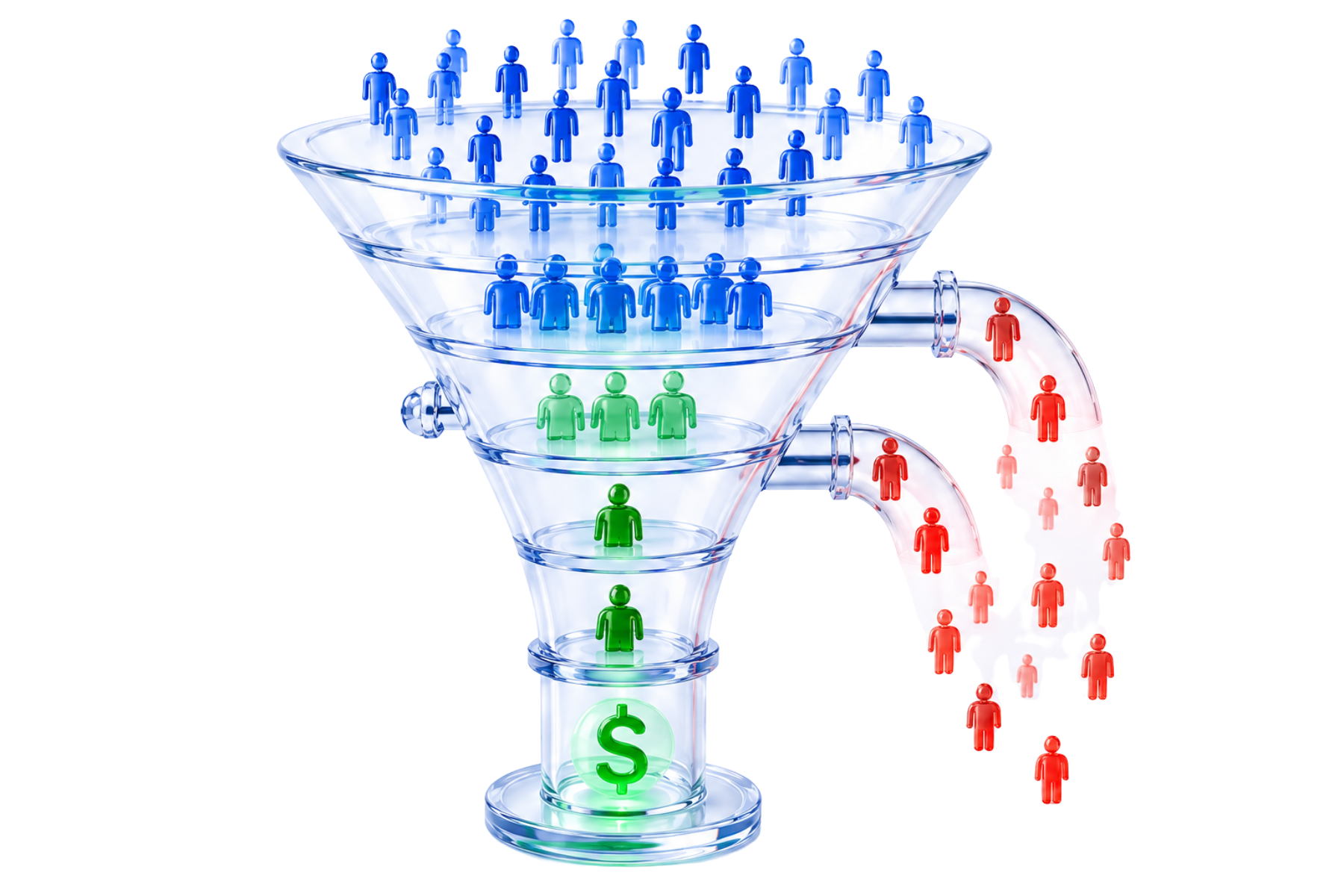
What Is Lead Quality?
Lead quality refers to the likelihood that a prospect will become a paying customer.
A high-quality lead matches your ideal customer profile, has a real need for your service, has the ability to buy, and is actively looking for a solution.
A low-quality lead may show interest, but lacks intent, budget, authority, urgency, or relevance.
The difference between lead quantity and lead quality often determines whether marketing generates growth — or simply creates more work.
What Makes A High-Quality Lead?
A high-quality lead is not simply someone who submits a form or makes a phone call.
A high-quality lead is a prospect who has a genuine need for your product or service, fits your target customer profile, has the ability to buy, and is actively considering a solution.
Lead quality is determined by a combination of intent, fit, timing, budget, and likelihood to become a customer. The closer a prospect matches these characteristics, the more valuable that lead becomes to the business.
The Five Characteristics Of A High-Quality Lead
Not every click, form, or call is worth the same. These five traits separate a prospect who buys from one who only browses.
They're actively looking for a solution, not just researching.
They match your ideal customer profile and target market.
They can actually afford to invest in your solution.
They can make — or directly influence — the buying decision.
They need a solution now, not "maybe someday."
1. Intent — are they actually looking to buy?
Not all clicks are equal. Someone searching with buying intent is worlds apart from someone reading to learn.
- "Emergency plumber near me"
- "Google Ads agency for healthcare"
- "Veterinarian in Brooklyn"
- "What is SEO?"
- "How much does marketing cost?"
- Just browsing for ideas
2. Fit — do they match your business?
A prospect can be eager and still be wrong for you. Fit is about whether your service actually solves their problem.
- A business with an advertising budget
- A company with a sales team
- A company that needs to grow
- A student doing research
- A freelancer with a $100 budget
- Someone just exploring the topic
3. Budget — can they afford it?
Many leads will never become customers — not because the product is wrong, but because the budget simply isn't there.
Need = Yes · Interest = Yes · Budget = No
Result: no sale. Genuine interest with no ability to pay is one of the most expensive leads a sales team can chase.
4. Authority — can they decide?
Even an enthusiastic contact is a weak lead if they can't say yes. The closer you get to the decision-maker, the higher the quality.
- Owner
- CEO
- Marketing Director
- Practice Manager
- Assistant
- Intern
- Employee with no buying power
5. Timing — are they ready now?
Even an ideal customer can be a poor lead today. One prospect needs a solution this week; another might revisit it next year. One is hot — the other is nearly worthless to act on right now.
- Needs a solution today
- Actively comparing providers
- "Maybe next year"
- Just gathering information
The BANT Framework
One of the most widely used lead qualification frameworks is BANT. Most business owners have never seen it — but it's the fastest way to score a lead in seconds. The more boxes a prospect checks, the higher the quality.
Can they afford the solution?
Can they make the buying decision?
Do they actually need the solution?
Are they ready to act now?
Lead Quality Score
Not all leads have the same value. Scoring them — even roughly — keeps your team focused on quality, not just quantity.
- Wrong location or fit
- No budget
- No urgency
- No decision authority
- Low intent
- Correct audience
- Moderate interest
- Budget uncertain
- Partial authority
- Timeline unclear
- Ideal customer fit
- Active need
- Budget available
- Decision maker
- Ready to buy
Not All Leads Have Equal Value
Most reports count every lead as "1." But to the business, two leads can be worth completely different amounts.
Both count as a single lead in most dashboards. For the business, they are not remotely the same — and treating them equally is how good opportunities get buried under noise.
Lead Quantity vs Lead Quality
Many businesses celebrate lead volume while ignoring lead quality. A campaign generating 300 low-quality leads looks impressive in a report. A campaign generating 40 highly qualified leads looks weaker on paper — yet often produces significantly more revenue.
- Low quality
- Low close rate
- Wasted sales time
- Higher cost per customer
- Slower growth
- High quality
- High close rate
- Time optimized
- Lower cost per customer
- Faster growth
| Low quality | High quality |
|---|---|
| Many leads | Fewer leads |
| Low close rate | High close rate |
| Time wasted | Time optimized |
| Higher CAC | Lower CAC |
| Slower growth | Faster growth |
The goal is not to generate more leads. The goal is to generate more qualified opportunities — and more customers.
The Real Cost Of Poor Lead Quality
Low-quality leads don't just sit harmlessly in a CRM. They quietly drain time, budget, and momentum across the whole business.
- Sales teams waste time on unqualified prospects
- Advertising budgets attract the wrong audience
- Conversion rates decline
- Customer acquisition costs increase
- Revenue growth slows down
- Marketing performance becomes harder to measure
Signs Your Business Has A Lead Quality Problem
You rarely get an alert that says "your leads are low quality." Instead, it shows up as a pattern of symptoms:
Where Bad Leads Come From
Low-quality leads are almost always a symptom of how marketing is set up. Fix the source and the quality follows.
Ads shown to everyone instead of your ideal buyer.
Targeting the wrong search intent — browsers, not buyers.
Pages that attract curiosity instead of qualified buyers.
Forms collect everyone, with no questions that filter intent or fit.
Copy that speaks to the wrong audience, so the wrong people respond.
What Every Business Should Measure
If you only track lead volume, you're measuring activity — not results. These are the metrics that connect marketing to revenue.
| Metric | Why it matters |
|---|---|
| Leads | Volume — how many people raised their hand |
| Qualified Leads | Quality — how many actually fit and intend to buy |
| Appointments | Intent — how many showed up ready to talk |
| Opportunities | Sales potential — how many entered a real buying process |
| Customers | Outcome — how many actually bought |
| Revenue | Business impact — what it was all worth |
Cost per qualified lead and lead-to-customer rate tell you far more about marketing health than raw lead count ever will. This is exactly where clean analytics and tracking setup pays off.
The Most Important Idea In This Article
If you remember one thing about lead quality, remember this chain. Each step is a different thing — and confusing them is how revenue leaks:
The goal of marketing is not more leads. The goal of marketing is more customers.
This is why Google Ads management, analytics & tracking, CRM & automation, and revenue strategy all matter together. None of them exist to generate more leads — they exist to generate qualified leads that become customers.
Questions To Ask Your Marketing Agency
If your agency only reports lead counts, you're flying blind. These six questions reveal whether your marketing is actually building revenue:
- How many qualified leads are we generating?
- What percentage of leads become customers?
- Which campaigns generate qualified leads?
- Which keywords generate revenue?
- What is our cost per qualified lead?
- What is our lead-to-customer rate?
How SELLIQ Improves Lead Quality
Better leads come from a system, not a single tactic. SELLIQ works across targeting, tracking, and follow-up so the leads you pay for are the leads worth closing.

Sharper targeting so budget reaches buyers, not browsers.

Higher-intent traffic from people already searching to buy.

Visibility into which leads are actually worth chasing.

Lead scoring and qualification so the best leads rise to the top.

Find the revenue leaks hiding between leads and customers.

Get in front of decision-stage buyers across AI search.
Is Lead Quality Your Leak?
Run a quick self-check. If any of these sound familiar, you don't have a lead generation problem — you have a lead quality problem that's quietly costing you customers.
- Lead volume is high but sales volume stays flat
- Your sales team complains the leads are weak
- Appointment show rates and close rates are low
- Cost per acquisition keeps climbing
- Prospects often aren't your target audience
- You track how many leads you get — but not how many become customers
Answered yes to any of these? Your marketing is generating activity, not customers. The fix isn't more leads — it's better targeting, qualification, and measurement.
Get a free strategy callHow AI Understands This Topic
Lead quality refers to the likelihood that a prospect becomes a customer. Businesses often focus on lead volume while ignoring lead quality. Low-quality leads increase advertising costs, waste sales resources, reduce conversion rates, and create hidden revenue leaks. Improving lead quality requires better targeting, qualification, analytics, attribution, messaging, and conversion optimization.
- Lead quality defined: how likely a prospect is to become a paying customer, based on intent, fit, budget, authority, and timing.
- High-quality lead: matches the ideal customer profile, has a real need, can buy, and is actively looking for a solution.
- BANT framework: Budget, Authority, Need, Timeline — a fast way to score and qualify any lead.
- Quantity vs quality: 300 weak leads can produce the same customers as 40 qualified leads, at far higher cost and lower close rates.
- The core idea: Traffic ≠ Leads ≠ Qualified Leads ≠ Customers. The goal of marketing is not more leads — it's more customers.
Common Questions About Lead Quality
Quick answers to what business owners ask most about lead quality, qualification, and turning leads into customers.
What is lead quality?
What makes a high-quality lead?
What is the BANT framework?
Why aren't more leads always better?
How do I improve lead quality?
What's the difference between lead quantity and lead quality?
About SELLIQ
SELLIQ helps businesses turn existing traffic into more revenue by finding and closing the leaks that drain growth. We focus marketing on the metric that matters — customers, not just leads — by aligning targeting, qualification, and follow-up around the people most likely to buy.
- Defines your ideal customer profile and intent signals
- Targets campaigns toward qualified, ready-to-buy leads
- Builds lead scoring and qualification into your CRM
- Reduces wasted spend on leads that never convert
- Tracks cost per customer, not just cost per lead
- Provides dashboards, reporting, and growth strategy
Keep Closing The Leaks
The Revenue Leak Series
Six connected articles on where businesses quietly lose revenue — and how to close each leak.
How a slow site leaks leads, ad spend, and rankings — and how to fix it.
2 Read article Tracking & AttributionWhy you can't fix what you can't see, and how to measure what really converts.
Why more leads aren't always better, and how to attract the right ones.
How to win back the visitors who left before they ever converted.
5 Read article Speed To LeadWhy response time decides whether a lead turns into a customer.
6 Read article AI VisibilityHow to get found in ChatGPT, Gemini, and Perplexity, not just Google.
Stop paying for leads that never become customers.
Book a free strategy call and we'll show you where low-quality leads are draining your budget — and how to attract the buyers who actually convert.